Passing On a Referral Code to Six New Miners Without Overselling It
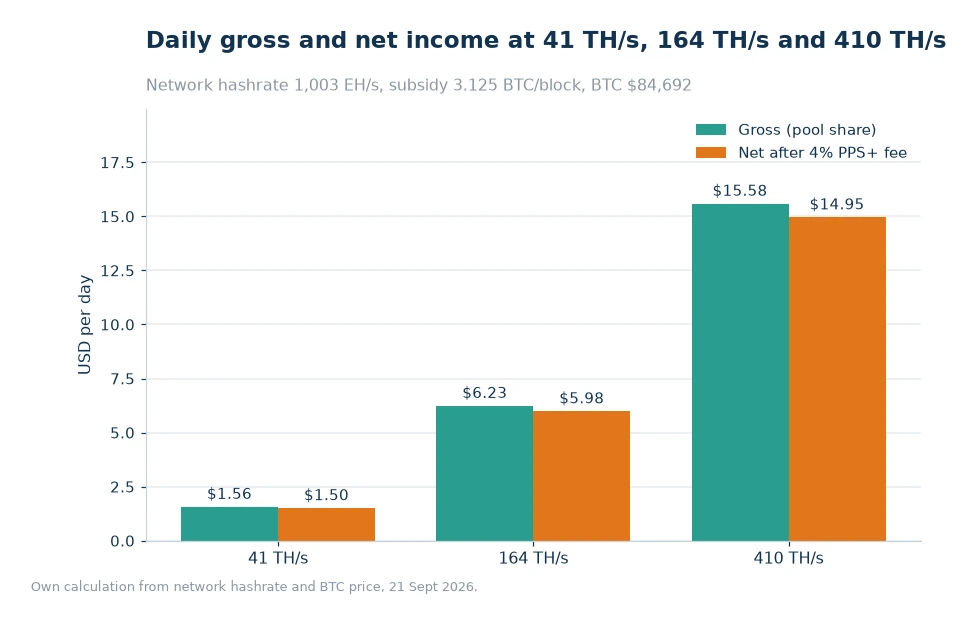
Six people asked for the signup code after a local meetup, and five of them had never pointed a miner at a pool. The smallest of them runs 41 TH/s, which at current network difficulty credits $1.50 a day after the listed 4%. That is the number the conversation has to start with, because anyone who expects more will blame the code, the pool or the person who shared it.

Key takeaways
- 41 TH/s nets $1.50 a day and $10.50 in a first week, which sets the honest scale of a small start.
- 410 TH/s nets $14.95 a day, so the same conversation sounds very different to a larger operator.
- A referral works when the newcomer understands payouts before they understand rewards.
- The person sharing the code should hand over a written first-week checklist, not a link alone.
What the person doing the introducing actually owes
Recommending a pool is a small act with a long tail. The newcomer will judge the service by their first payout, and they will judge the person who recommended it by the same event. That makes the introduction a support task, not a share button. The minimum is to explain what the pool does, what it charges and what a realistic first month looks like at their hashrate.
It also means saying what the pool is not. It is not a savings account, it does not fix a bad power rate and it cannot make a 41 TH/s machine into a business. Setting those expectations early costs ten minutes. Skipping them costs a friendship when the first difficulty rise arrives and the daily figure drops.
The ViaBTC Referral page explains how the programme is structured and what the current terms are. Read it before forwarding it. A code passed on without reading the terms is a promise made on someone else's behalf.
The first week is where newcomers lose the thread
Three things go wrong in the first seven days. The worker never appears because the miner is pointed at the wrong address. The payout arrives but the newcomer cannot find it because they are looking at a different coin balance. Or the machine runs for two days and then stops, and nobody notices because no alert was configured.
Each has a simple fix. Copy the pool address from the account rather than retyping it. Show the wallet balance screen once, in person or on a call. Set one alert for a hashrate drop before the machine is left alone. None of this is advanced, and all of it is the difference between a newcomer who stays and one who concludes that mining does not work.
A written checklist of five lines beats a verbal explanation, because the newcomer can follow it at 11 p.m. without calling anyone. The checklist should include the pool address, the worker name, the expected daily credit at their hashrate and the support page address.
Two of the six will ask about mobile access within the first week. Answer it before they ask: show them where the app shows live hashrate and where it shows the balance, and note that an alert configured on day one is worth more than a dashboard checked on day nine. The people who stay are usually the ones who saw the machine working, not the ones who read the most about it.
Keeping the introduction boring and accurate
Enthusiasm is the enemy here. A newcomer who hears "you will double your money" will buy too much hardware, and the resulting disappointment lands on the pool even though the arithmetic was never on their side. A newcomer who hears "at 164 TH/s you are looking at about $5.98 a day before power" will buy one machine, measure it and decide from evidence.
Accuracy also means distinguishing gross from net. The listed 4% applies to the block-reward component, and the transaction-fee component follows a different rule. Quoting one blended number to a beginner is a shortcut that eventually produces an argument. Quote the gross, then the net, then the difference.
When someone asks which settlement mode to choose, describe the two shapes rather than picking for them. One pays hourly against current difficulty; the other pays after six confirmations over a five-round window and carries more variance. The right answer depends on whether they need steady cash or can tolerate swings.
| Newcomer's rig | Hashrate | Daily net | First week | First month |
|---|---|---|---|---|
| Single small unit | 41 TH/s | $1.50 | $10.50 | $45.00 |
| Four-unit shelf | 164 TH/s | $5.98 | $41.86 | $179.40 |
| Small container | 410 TH/s | $14.95 | $104.65 | $448.50 |
Accounting for a shared code
If the code earns something for the person who shares it, that fact belongs in the conversation. Hiding it turns a helpful introduction into a sales pitch discovered later. Saying it plainly — "I get a benefit if you sign up with this, and here is what it is" — removes the awkwardness and lets the newcomer decide with full information.
Keep a simple record of who joined, when and at what hashrate. Not for the reward, but for support. When one of the six reports a missing payout, the record tells you whether they are on their first week or their third month, which changes the answer. It also stops the same question being answered from memory six times.
Worked example
Take the 41 TH/s newcomer and show what the first month actually looks like, including the part nobody enjoys explaining.
- Each terahash earns 450 ÷ 1,003,000,000 = 0.00000044865 BTC of the daily issuance.
- At 41 TH/s: 41 × 0.00000044865 = 0.00001840 BTC a day.
- At $84,692: 0.00001840 × 84,692 = $1.558, or $1.56 gross.
- After the listed 4%: 1.558 × 0.96 = $1.4955, or $1.50 net.
- First week: 1.4955 × 7 = $10.47, shown as $10.50 at the rounded daily rate.
- First month: 1.4955 × 30 = $44.87, or $45.00 at the rounded rate.
- At 410 TH/s, ten times the hashrate, the month is $448.50 net.
Then subtract power. A 41 TH/s machine at 20 J/TH draws 820 watts, which is 19.68 kWh a day. At $0.06 per kWh that is $1.18 a day, leaving roughly $0.32. The introduction is honest only if that line is mentioned, because it is the line that decides whether the machine should run at all.
Frequently asked questions
What should I tell someone before sharing a referral code?
Tell them the daily net at their hashrate, the power cost that comes out of it and the fact that difficulty changes the figure. At 41 TH/s that means about $1.50 a day before electricity, not a monthly salary.
Does the person who refers earn from my mining?
The programme's terms set out any benefit, and they are worth reading before signing up. Sharing a code that pays the referrer is fine as long as the newcomer is told; discovering it later is what damages trust.
Why did my first payout look smaller than the estimate?
Estimates assume 24 hours of continuous uptime at one difficulty reading. A late start, a short outage or a difficulty change inside the period all reduce the first credit, and the gap is usually explained by one of those three.
Write the handover note before the code
One page, six lines: pool address, worker naming rule, expected daily net, power cost, alert threshold and support link. Hand it over with the code. The newcomer who can answer their own questions in week one is the one who is still mining in month six.
The Profit Calculator will reproduce the daily figure at any hashrate, and the mobile app is the easiest way for a beginner to watch the first credits land. Send both links with the note, and the introduction has a chance of surviving contact with a real electricity bill.
Sources: the ViaBTC referral, calculator and app pages for programme terms and estimation tools[1]. Data on 21 Sept 2026 showed 1,003 EH/s network hashrate, 132.76 T difficulty and BTC at $84,692. The power example uses 20 J/TH and a $0.06 tariff. Published 24 Oct 2026.